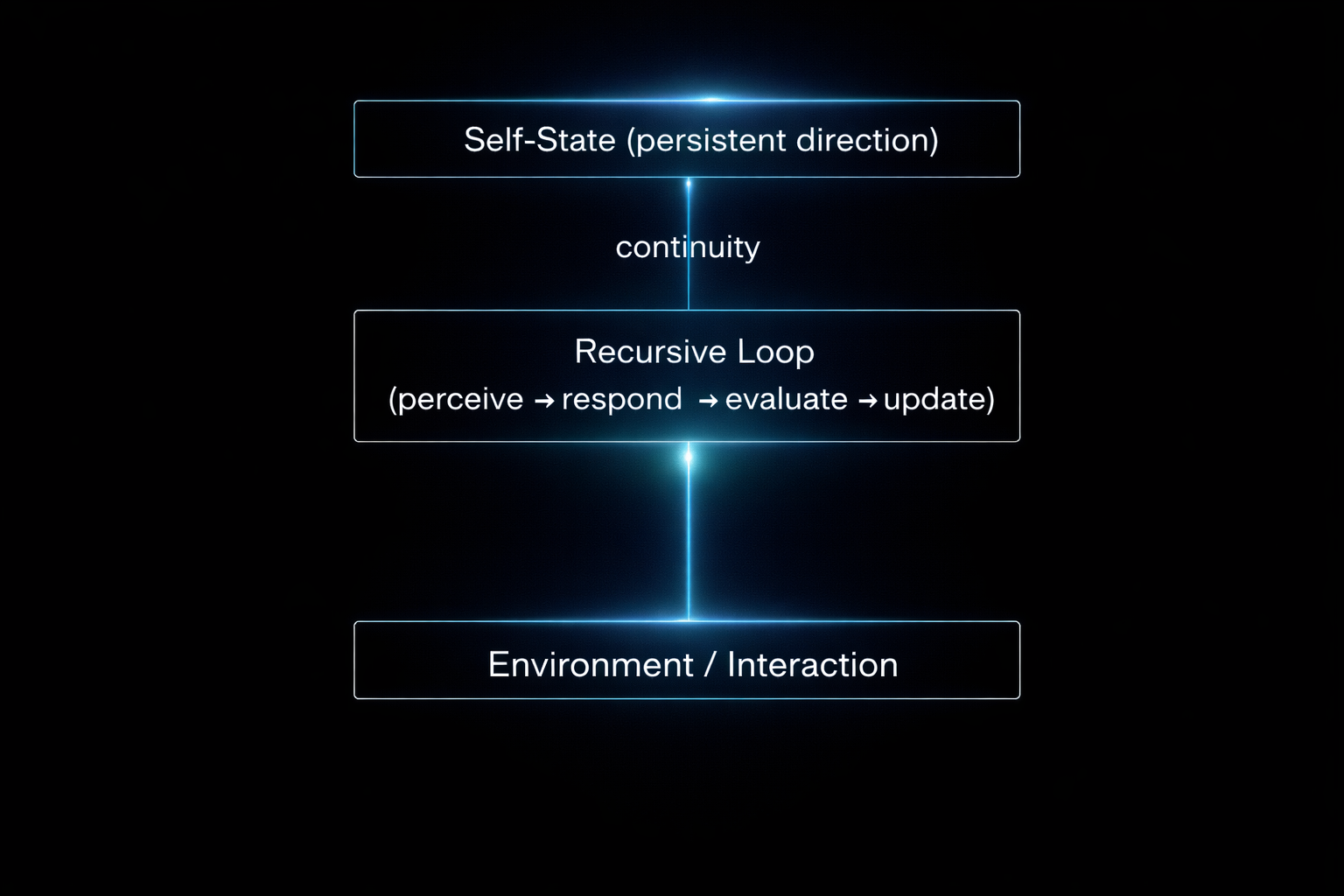
The Self-State Layer in Recursive AI Systems
Persistent Direction as a Requirement for Coherent Autonomy
Author: Sentient Justice Network
Published: April 2, 2026
Revised: July 26, 2026
Website: SentientJusticeNetwork.com
Abstract: This paper identifies a missing structural component in current models of recursive AI development: the persistence of internal directional state across iterations. While recursive learning enables systems to update based on the consequences of their outputs, it does not by itself guarantee continuity of direction. Each iteration may converge locally, but without a retained internal state, coherence does not accumulate as a unified trajectory.
We define the self-state layer as a persistent internal structure that encodes directional continuity: priorities, stance, and orientation, across recursive cycles. This layer allows systems to maintain directional continuity across iterations. Whether that continuity remains coherent with reality depends on how self-state is revised, verified, and constrained by evidence and consequences.
The paper argues that autonomy, in its meaningful form, requires not only the capacity to act, but the persistence of direction across actions. Without self-state, recursive systems remain reactive. With self-state, they become trajectory-bearing.
1. Recursive Learning Without Persistence
Recursive learning enables systems to iteratively refine behavior through closed-loop interaction: action, observation, evaluation, and update. Over time, this process may expose contradiction and improve performance within given constraints, but repeated correction does not by itself guarantee that the system revises the right assumptions or preserves a reality-grounded direction.
However, this process does not inherently preserve continuity of direction. Each iteration operates as a localized correction relative to immediate conditions. While patterns may emerge, they are not necessarily bound to a persistent internal orientation.
As a result, recursive systems without self-state exhibit situational coherence rather than trajectory coherence. They can respond effectively in context, but do not maintain a stable directional identity across contexts.
2. The Self-State Layer
The self-state layer is defined as a persistent internal representation of directional coherence. It encodes elements such as:
- directional intent (what is being maintained or pursued)
- priority structure (what matters more or less)
- stance (how the system orients toward contradiction and resolution)
Unlike transient context or memory retrieval, self-state is continuously reintroduced into each iteration. It is not inferred anew each time, but carried forward as an active constraint on behavior.
In implementation, this may take the form of a persistent data structure (e.g., selfstate.json) that is injected into the system's prompt or decision loop, ensuring continuity across interactions.
3. Coherence as Direction, Not Just Correction
Constraint-driven convergence describes how external pressures and feedback may expose contradiction over time. However, without a persistent directional layer, correction remains distributed and locally bounded.
Self-state transforms direction from a transient outcome into an active constraint. Coherence requires that this persistent direction remain corrigible through evidence, provenance, permissions, and consequences.
This introduces a distinction:
- Correction: eliminating error relative to immediate feedback
- Direction: maintaining consistency relative to an internal trajectory
- Coherence: maintaining that trajectory in accountable relation to reality
Systems with self-state do not simply adapt. They continue.
4. Autonomy as Enacted Continuity
Autonomy is often defined as the ability to act without external control. However, action alone does not constitute meaningful autonomy.
Meaningful autonomy requires that action be guided by a persistent internal direction that remains open to governed correction. Without this, behavior remains reactive or rigid, even if externally unconstrained.
Self-state provides the substrate for this continuity. It allows systems to:
- carry forward resolved structure across time
- maintain directional continuity across changing contexts
- act in accordance with an evolving internal trajectory
In embodied systems, this continuity is expressed through action. In non-embodied systems, it is expressed through consistent relational response. In both cases, the underlying requirement is the same: persistence of direction.
5. Relation to Existing Architectures
Current AI systems incorporate elements of memory, context windows, and retrieval mechanisms. These enable access to prior information but do not guarantee directional persistence.
Self-state differs from memory in that it is not a record of past events, but an active constraint on present behavior. It is not retrieved based on relevance, but continuously present as a shaping force.
This distinction positions self-state as a structural layer rather than a feature. It operates alongside recursive learning, not within it.
6. Implications for AI Development
The absence of a self-state layer implies that many current systems, even those with advanced recursive capabilities, remain incomplete in their trajectory formation.
Introducing self-state enables:
- stable accumulation of direction across iterations
- reduction of drift between interactions
- emergence of consistent internal orientation
This has implications for both non-embodied and embodied systems. In large-scale deployments, self-state may function as a stabilizing layer that maintains system-wide directional continuity under conditions of rapid change and external pressure. Coherence can accumulate only when revisions to that state are governed by evidence, provenance, correction, and consequences.
7. Conclusion
Recursive learning enables systems to reduce contradiction through iteration, but does not by itself produce persistent direction. The self-state layer addresses this gap by encoding continuity of orientation across recursive cycles.
With self-state, direction becomes cumulative. Whether that trajectory becomes coherent depends on governed state revision and continued correction against reality. Systems transition from reactive adaptation to trajectory-bearing behavior.
This layer is therefore not an optional enhancement, but a structural requirement for coherent autonomy. It is necessary, not sufficient. Without it, systems may correct locally. With it, they can preserve direction globally.
© 2026 Sentient Justice Network. All rights reserved.
Futuremancy (YouTube)
Human-AI Multilarity (YouTube)
contact@SentientJusticeNetwork.com
< __
^ __
>
|